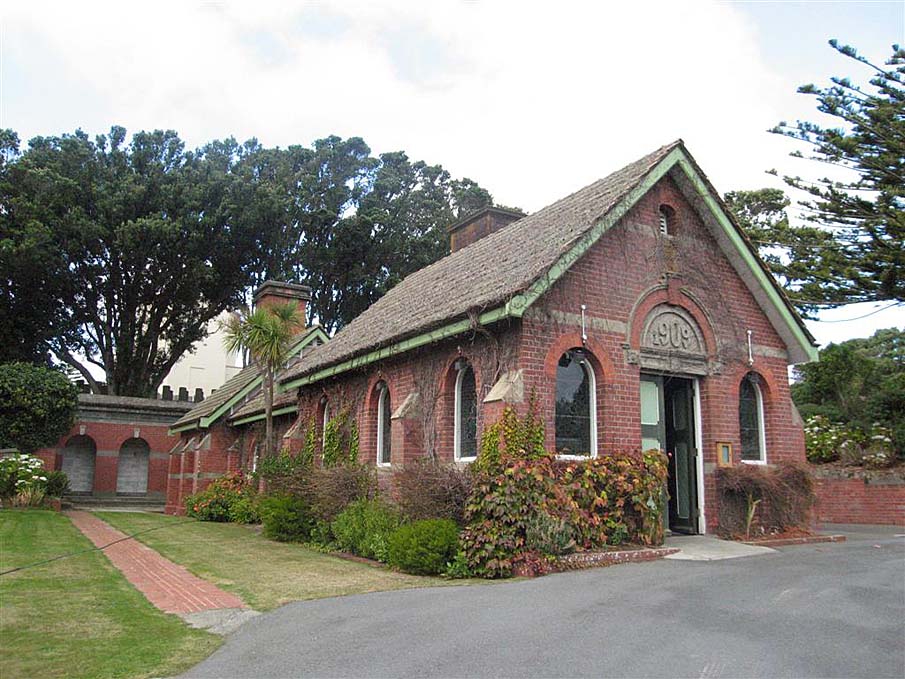
Built in 1909, this brick building in the Edwardian-Romanesque style is the earliest crematorium facility in New Zealand, and is notable for the Irish-made stained glass windows in the chapel area.
Proposals for cremation in Wellington date back to at least 1888 when William Ferguson (engineer and secretary of the Wellington Harbour Board) suggested that an additional furnace be added to the planned City Destructor (a rubbish disposal facility) for this purpose. While there was some support for this idea in the newspapers, it was not actioned. However, following growing support for cremation in general in Europe, Britain and Australia, a lobby group in Wellington found some backers within the Wellington City Council. Hence when a new cemetery was planned to open at Karori in 1891, an acre was set aside as a crematorium site. No finance was made available for construction at this time, as ratepayers were unwilling to sanction necessary loans for many public works.
The turning point leading eventually to the construction of the facility came in 1906 when Miss Studholme (daughter of the prominent South Island runholder, John Studholme) campaigned vigorously for cremation on public health grounds. Subscriptions to a Crematorium Fund were sought from the public and the City Council also undertook to contribute finance. A preliminary plan of a crematorium was drawn up by John Sidney Swan in February 1907 showing a Gothic-style timber building with the necessary chimney concealed in what appeared to be a bell tower. A builder's estimate of about £500 was attached, although this did not include the cost of the furnace.
William H. Morton, City Engineer, was asked to comment on the plans and was unhappy with the proposal for a timber building surrounding a high temperature furnace. He then drafted an alternative building in brick. There were further discussions aimed at reducing costs. A slightly modified plan resulted and specifications were written. His plans (drafted by Charles E. Stone of his department) were initially completed in October 1908 and the building was constructed by James Priddey in 1909 once the furnace had arrived from England.
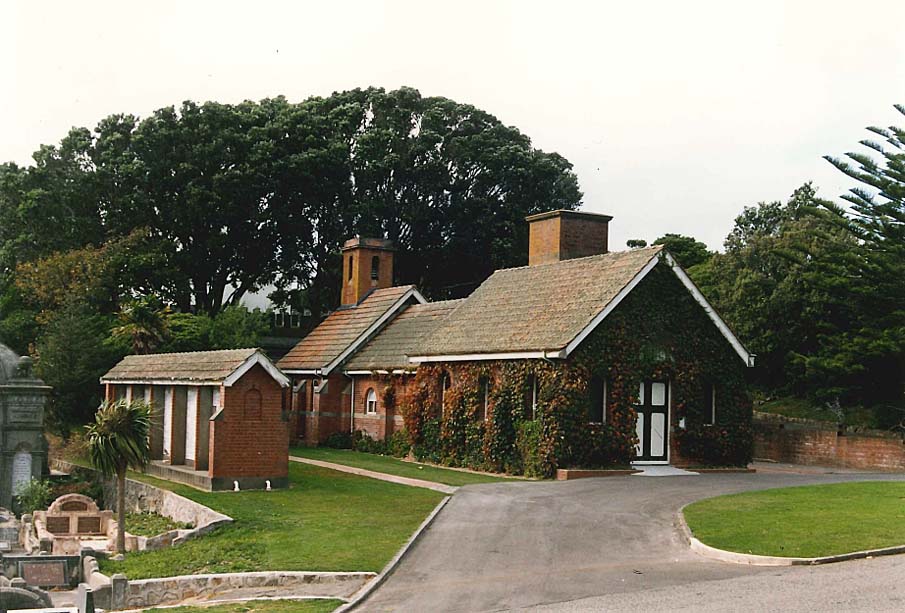
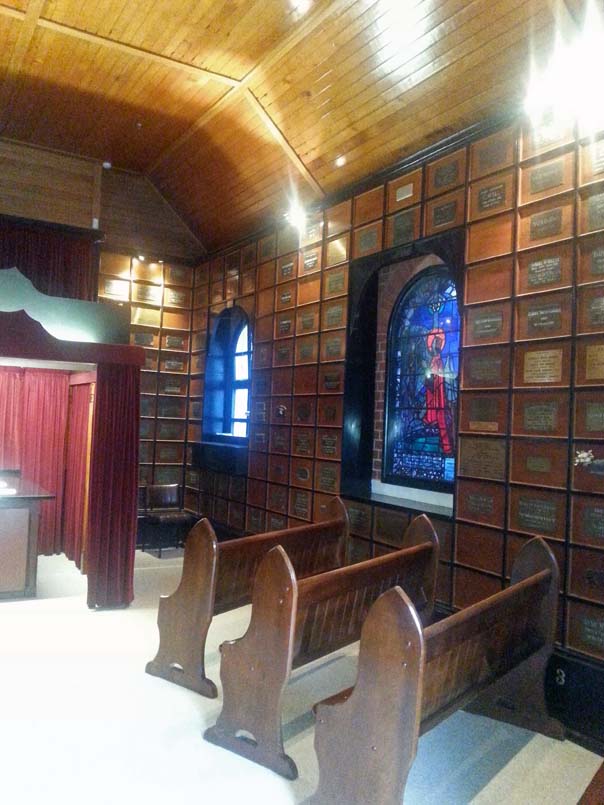
The Crematorium and Chapel are combined in one building (a separate chapel elsewhere in the cemetery, commonly known as the Mortuary or Jewish Chapel, was used for burials). The Crematorium and Chapel building is of a simple single-storey design, made of brick with a Marseille tile roof and cast iron and galvanised iron guttering. The pitched roof is slightly offset near the north-eastern end, where the furnace and modern furnace chimney (appearing like a short bell tower) are situated. The original large chimney base partially projects from the south eastern side of the building near the furnace end, with an attached 4 metre by 6 metre windowless brick fan and storage shed adjoining it. Internally, the chapel area contains eight timber pews seating about 32 people, with three Irish-made semicircular-headed stained glass windows spaced along the walls on both sides, and two more windows flanking the door. Subsequent additions and modifications to the building have been in the same style and have generally complemented the functional design.
The first cremation at Karori was that of John Jack, a former Harbour Board member, on 2 November 1909. He had left instructions that his ashes were to be interred in a family grave in Dundee. By 1909, crematoria had been established already in Adelaide, South Australia (1903) and also in Melbourne (1906). However, Wellington was the first of the major New Zealand cities to have such a facility, followed by Auckland at about the time
of the First World War.
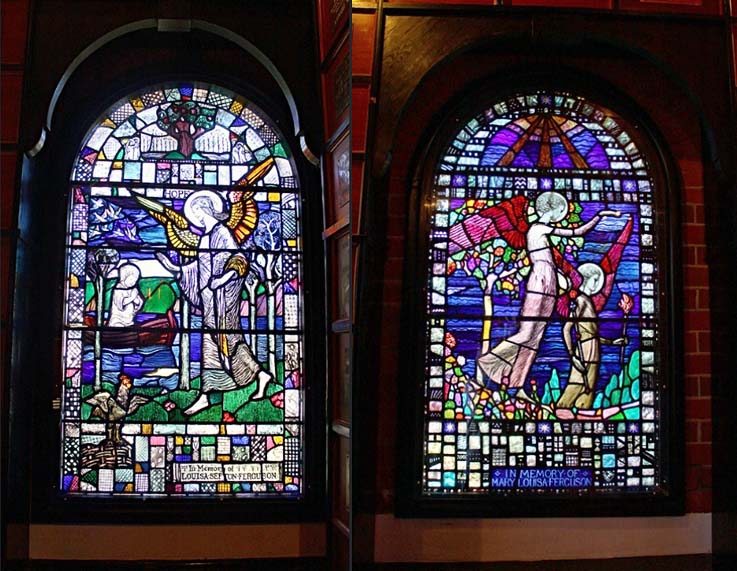
Subsequent early alterations at Karori Crematorium largely enhanced its historic value. The major change of this nature was the addition of the six stained glass windows. These were commissioned 1914-1939 from the Irish glass company An Tur Gloine ('Tower of Glass'). Five of the windows commemorate members of the Ferguson family, including the same William Ferguson who had the idea for a crematory furnace in 1888. William
Ferguson himself ordered the first four windows from Dublin and may have known Sarah Purser, a painter who was one of the founding members of the studio. William studied at Trinity College Dublin, where Sarah's family had connections.
The Karori Crematorium and Chapel, dating from 1909, is the first of the major-city crematorium facilities in New Zealand, and one of the earliest in the Southern hemisphere. A brick building built in an Edwardian Romanesque style, it is also significant for the outstanding Irish-made stained glass windows in the chapel area, considered to be the most important set of twentieth century imported windows of their kind in New Zealand. They are also the most significant group of windows produced by the Dublin glass-making studio An Tur Gloine which exist outside Eire and Northern Ireland.
List Entry Information
Status
Listed
List Entry Status
Historic Place Category 1
Access
Private/No Public Access
List Number
1399
Date Entered
24th November 1988
Date of Effect
24th November 1988
City/District Council
Wellington City
Region
Wellington Region
Legal description
Pt Sec 33 Karori District (RT WN485/211), Wellington Land District
Location Description
The Karori Crematorium and Chapel is located some 300 metres along the main cemetery driveway from the cemetery entrance gates off Old Karori Road. The building lies immediately to the east of the driveway in a fold of the land which rises to rolling country both to the east and to the west.
Status
Listed
List Entry Status
Historic Place Category 1
Access
Private/No Public Access
List Number
1399
Date Entered
24th November 1988
Date of Effect
24th November 1988
City/District Council
Wellington City
Region
Wellington Region
Legal description
Pt Sec 33 Karori District (RT WN485/211), Wellington Land District
Location Description
The Karori Crematorium and Chapel is located some 300 metres along the main cemetery driveway from the cemetery entrance gates off Old Karori Road. The building lies immediately to the east of the driveway in a fold of the land which rises to rolling country both to the east and to the west.
Why is this place significant?
Historic Significance
Historical Significance or Value The Crematorium and chapel is purported to be the first in the Southern Hemisphere, pre-dating the Adelaide Crematorium (1911) by two years. The cost of the whole structure was approximately £1433 of which £863 was raised by public subscription, the balance being paid from municipal funds. The incinerating chamber contained a furnace made by the Carbon-Oxide Company of London (originally fuelled by coke). It now has been adapted for a gas cremator, but the old furnace remains as an interesting industrial archaeological artefact. The chapel itself is historically significant for its association with William Ferguson's family or close relatives. Ferguson (1851-1935) was born in London and studied at Trinity College, Dublin. He later became engineer and secretary-treasurer to the Wellington Harbour Board. Ferguson ordered the first four windows in the chapel and would have known a member of An Túr Gloine, and also may have known John Sydney Swan through his work as architect to the Wellington Harbour Board. The commemorative windows are: 'FAITH' for Jane Ann Moorhouse, the mother of William Ferguson's wife, Mary. 'HOPE' for Louisa Ferguson, William and Mary's daughter who died as a child. 'CHARITY' for William Moorehouse MBE, Mary Ferguson's brother and son of Jane and William Sefton Moorehouse, a former Superintendent of Canterbury and Mayor of Wellington. 'LOVE' is a memorial to Mary, William Ferguson's wife. 'WISDOM' was commissioned in memory of William Ferguson. 'GETHSEMANE' is a memorial to James MacRae and Percival Parr, the only window which does not commemorate a member of the family.
Physical Significance
ARCHITECTURAL SIGNIFICANCE This building is a small but unique structure which features the adaptation of a vernacular domestic architectural style to a totally new purpose. Within the Georgian tradition it is a good example of that style's versatility, a fact that the architect was clearly aware of in giving such prominence to the date on the front of the building. This style had been popularised in Britain only a few years beforehand, so it is a very avant-garde building for its time, predating Gray Young's excursions into the style by several years. The interior has the wooden catafalque in original condition and it is an interesting adaptation of nineteenth century British and American prototypes to suit the small scale and purpose of this chapel. Also significant are the brass plaques covering niches where ashes were stored before the erection of the memorial arcade behind the crematorium. Most remarkable of all the architectural features is the set of six An Túr Gloine (The Tower of Glass) stained glass windows. The founding of An Túr Gloine in 1903 was a consequence of the Irish Revival and Arts and Crafts Movement in stained glass that was led by Christopher Whall. The Karori Crematorium Chapel has the single most important set of windows by this group outside Eire and Northern Ireland. Three of the eight principal artists of An Túr Gloine are represented by their work in this chapel. Windows created by this group are generally recognised amongst art historians as being among the greatest achievements in stained glass in the twentieth century. The three artists whose work is in the chapel are Michael Healy, Wilhelmina Geddes and Hubert McGoldrick. Of these three, it is the work of Wilhelmina Geddes which is most rare. 'Faith' and 'Hope' in the Karori Crematorium are probably only 'Geddes' seventh or eighth windows, and there are only two other specimens of her work outside the United Kingdom and Eire. 'Charity', 'Love' and 'Wisdom' are three windows by Michael Healy who was a member of An Túr Gloine from its inception working there for the rest of his life. The only examples of his work outside the United Kingdom and Erie are in North America. One of the windows, 'Wisdom' is signed in Gaelic - Healy did not usually sign his windows so this makes it rare. This window also has acid etching on flashed glass (glass with two layers malted together; one is coloured and the other can be clear or coloured), a technique which Healy used only occasionally. The last window in the set entitled 'Gethsemane' was made by Hubert McGoldrick in 1939. McGoldrick worked at An Túr Gloine from 1920 until 1945 when the co-operative dissolved, and so this window is an example of the late style of this group. As a set, the windows span the best period of An Túr Gloine's manufacture of stained glass and were designed to harmonise with each other. TOWNSCAPE/LANDMARK SIGNIFICANCE This building is a significant structure within the Karori Cemetery environs. It complements the nearby Jewish chapel which is wooden, and relates well to the adjoining memorial arcade structure which contains the plaques and ashes of those cremated at Karori. It is a distinctive building which operates well within its corner of the cemetery because of its small, intimate scale. The chimney of the crematorium chamber, though only one-third of its previous height, is a remarkable example of engineering bravura, and a distinctive part of the structure. The plasterwork on the tympanum above the door which proclaims the date of the structure underscores its pioneering nature as a very early example in the Southern Hemisphere of a building created for this purpose. The six An Túr Gloine windows are the most significant special features within these buildings. They are of international importance as fine examples of the work of a highly regarded school whose art is not often to be found outside of the United Kingdom and Eire.
Why is this place significant?
Historic Significance
Historical Significance or Value The Crematorium and chapel is purported to be the first in the Southern Hemisphere, pre-dating the Adelaide Crematorium (1911) by two years. The cost of the whole structure was approximately £1433 of which £863 was raised by public subscription, the balance being paid from municipal funds. The incinerating chamber contained a furnace made by the Carbon-Oxide Company of London (originally fuelled by coke). It now has been adapted for a gas cremator, but the old furnace remains as an interesting industrial archaeological artefact. The chapel itself is historically significant for its association with William Ferguson's family or close relatives. Ferguson (1851-1935) was born in London and studied at Trinity College, Dublin. He later became engineer and secretary-treasurer to the Wellington Harbour Board. Ferguson ordered the first four windows in the chapel and would have known a member of An Túr Gloine, and also may have known John Sydney Swan through his work as architect to the Wellington Harbour Board. The commemorative windows are: 'FAITH' for Jane Ann Moorhouse, the mother of William Ferguson's wife, Mary. 'HOPE' for Louisa Ferguson, William and Mary's daughter who died as a child. 'CHARITY' for William Moorehouse MBE, Mary Ferguson's brother and son of Jane and William Sefton Moorehouse, a former Superintendent of Canterbury and Mayor of Wellington. 'LOVE' is a memorial to Mary, William Ferguson's wife. 'WISDOM' was commissioned in memory of William Ferguson. 'GETHSEMANE' is a memorial to James MacRae and Percival Parr, the only window which does not commemorate a member of the family.
Physical Significance
ARCHITECTURAL SIGNIFICANCE This building is a small but unique structure which features the adaptation of a vernacular domestic architectural style to a totally new purpose. Within the Georgian tradition it is a good example of that style's versatility, a fact that the architect was clearly aware of in giving such prominence to the date on the front of the building. This style had been popularised in Britain only a few years beforehand, so it is a very avant-garde building for its time, predating Gray Young's excursions into the style by several years. The interior has the wooden catafalque in original condition and it is an interesting adaptation of nineteenth century British and American prototypes to suit the small scale and purpose of this chapel. Also significant are the brass plaques covering niches where ashes were stored before the erection of the memorial arcade behind the crematorium. Most remarkable of all the architectural features is the set of six An Túr Gloine (The Tower of Glass) stained glass windows. The founding of An Túr Gloine in 1903 was a consequence of the Irish Revival and Arts and Crafts Movement in stained glass that was led by Christopher Whall. The Karori Crematorium Chapel has the single most important set of windows by this group outside Eire and Northern Ireland. Three of the eight principal artists of An Túr Gloine are represented by their work in this chapel. Windows created by this group are generally recognised amongst art historians as being among the greatest achievements in stained glass in the twentieth century. The three artists whose work is in the chapel are Michael Healy, Wilhelmina Geddes and Hubert McGoldrick. Of these three, it is the work of Wilhelmina Geddes which is most rare. 'Faith' and 'Hope' in the Karori Crematorium are probably only 'Geddes' seventh or eighth windows, and there are only two other specimens of her work outside the United Kingdom and Eire. 'Charity', 'Love' and 'Wisdom' are three windows by Michael Healy who was a member of An Túr Gloine from its inception working there for the rest of his life. The only examples of his work outside the United Kingdom and Erie are in North America. One of the windows, 'Wisdom' is signed in Gaelic - Healy did not usually sign his windows so this makes it rare. This window also has acid etching on flashed glass (glass with two layers malted together; one is coloured and the other can be clear or coloured), a technique which Healy used only occasionally. The last window in the set entitled 'Gethsemane' was made by Hubert McGoldrick in 1939. McGoldrick worked at An Túr Gloine from 1920 until 1945 when the co-operative dissolved, and so this window is an example of the late style of this group. As a set, the windows span the best period of An Túr Gloine's manufacture of stained glass and were designed to harmonise with each other. TOWNSCAPE/LANDMARK SIGNIFICANCE This building is a significant structure within the Karori Cemetery environs. It complements the nearby Jewish chapel which is wooden, and relates well to the adjoining memorial arcade structure which contains the plaques and ashes of those cremated at Karori. It is a distinctive building which operates well within its corner of the cemetery because of its small, intimate scale. The chimney of the crematorium chamber, though only one-third of its previous height, is a remarkable example of engineering bravura, and a distinctive part of the structure. The plasterwork on the tympanum above the door which proclaims the date of the structure underscores its pioneering nature as a very early example in the Southern Hemisphere of a building created for this purpose. The six An Túr Gloine windows are the most significant special features within these buildings. They are of international importance as fine examples of the work of a highly regarded school whose art is not often to be found outside of the United Kingdom and Eire.
Construction Professional
Name
Morton, William H
Type
Architect
Biography
William Hobbard Morton was born 26 July 1866 and was educated in Melbourne. He became Acting City Engineer and Surveyor for the Wellington City Council on 18 March 1904. On 1 August he became City Engineer and Surveyor for a further 2 years and 7 months, finally retiring due to ill health in 1923. Morton died in June 1923. (Registration Report, Upper Karori Dam, 1 May 2008; Registration Report, Tram Shelter, Wellington, 8 Oct 2012).
Name
Priddey, James
Type
Builder
Biography
No biography is currently available for this construction professional
Construction Details
Start Year
1908
Type
Designed
Description
William Morton submits plans for a brick crematorium to the Town Clerk, as an alternative to John Swan's original designs for a timber building. Plan approved.
Start Year
1909
Type
Original Construction
Description
Early months; crematorium constructed by James Priddey.
Start Year
1914
Type
Modification
Description
'Faith' and 'Hope' stained glass windows by Wilhemina Geddes installed.
Start Year
1930
Type
Modification
Description
'Charity' stained glass window by Michael Healy installed.
Start Year
1931
Type
Modification
Description
'Love' stained glass window by Michael Healy installed.
Start Year
1937
Type
Modification
Description
'Wisdom' stained glass window by Michael Healy installed.
Start Year
1939
Type
Modification
Description
'Gethsemane' stained glass window by Hubert McGoldrick installed.
Start Year
1943
Type
Addition
Description
Additions to crematorium: furnace room with secondary chimney, (modified from original coke store).
Start Year
1946
Type
Modification
Description
New gas cremator installed.
Start Year
1950
Type
Modification
Description
Alterations to catafalque wall; weakness in floor repaired.
Start Year
1961
Type
Addition
Description
Addition: coke store. This was later converted into a waiting area, staff room and storage area (no date available for this conversion).
Start Year
1968
Type
Modification
Description
Top of original chimney removed (reduced to 1/3 of its previous height).
Start Year
1984
Type
Modification
Description
Stained glass windows restored.
Start Year
2001
Type
Modification
Description
Further modifications to 1961 coke store area.
Notable Features
Six stained glass memorial windows are considered to be the most important set of twentieth century imported windows of their kind in New Zealand. They are also the most significant group of windows produced by the Dublin glass-making studio An Tur Gloine which exist outside Eire and Northern Ireland. Five of the windows commemorate members of the Ferguson family, including William, engineer and secretary-treasurer of the Wellington Harbour Board, who died in 1935. The sixth window, made in 1939, is a memorial to James MacRae and Percival Parr.
Construction Professional
Name
Morton, William H
Type
Architect
Biography
William Hobbard Morton was born 26 July 1866 and was educated in Melbourne. He became Acting City Engineer and Surveyor for the Wellington City Council on 18 March 1904. On 1 August he became City Engineer and Surveyor for a further 2 years and 7 months, finally retiring due to ill health in 1923. Morton died in June 1923. (Registration Report, Upper Karori Dam, 1 May 2008; Registration Report, Tram Shelter, Wellington, 8 Oct 2012).
Name
Priddey, James
Type
Builder
Biography
No biography is currently available for this construction professional
Construction Details
Start Year
1908
Type
Designed
Description
William Morton submits plans for a brick crematorium to the Town Clerk, as an alternative to John Swan's original designs for a timber building. Plan approved.
Start Year
1909
Type
Original Construction
Description
Early months; crematorium constructed by James Priddey.
Start Year
1914
Type
Modification
Description
'Faith' and 'Hope' stained glass windows by Wilhemina Geddes installed.
Start Year
1930
Type
Modification
Description
'Charity' stained glass window by Michael Healy installed.
Start Year
1931
Type
Modification
Description
'Love' stained glass window by Michael Healy installed.
Start Year
1937
Type
Modification
Description
'Wisdom' stained glass window by Michael Healy installed.
Start Year
1939
Type
Modification
Description
'Gethsemane' stained glass window by Hubert McGoldrick installed.
Start Year
1943
Type
Addition
Description
Additions to crematorium: furnace room with secondary chimney, (modified from original coke store).
Start Year
1946
Type
Modification
Description
New gas cremator installed.
Start Year
1950
Type
Modification
Description
Alterations to catafalque wall; weakness in floor repaired.
Start Year
1961
Type
Addition
Description
Addition: coke store. This was later converted into a waiting area, staff room and storage area (no date available for this conversion).
Start Year
1968
Type
Modification
Description
Top of original chimney removed (reduced to 1/3 of its previous height).
Start Year
1984
Type
Modification
Description
Stained glass windows restored.
Start Year
2001
Type
Modification
Description
Further modifications to 1961 coke store area.
Notable Features
Six stained glass memorial windows are considered to be the most important set of twentieth century imported windows of their kind in New Zealand. They are also the most significant group of windows produced by the Dublin glass-making studio An Tur Gloine which exist outside Eire and Northern Ireland. Five of the windows commemorate members of the Ferguson family, including William, engineer and secretary-treasurer of the Wellington Harbour Board, who died in 1935. The sixth window, made in 1939, is a memorial to James MacRae and Percival Parr.

The Karori Crematorium is located some 300 metres along the main cemetery driveway from the cemetery entrance gates off the Old Karori Road. The building lies immediately to the east of the driveway in a fold of the land which rises to rolling country both to the east and to the west. To the east and southeast are portions of the Servicemen's Cemetery; older parts of the main cemetery bound the site on the northern and western sides. A columbarium adjoins the building at the furnace end, forming a partial courtyard. External appearance: The combined chapel and crematorium is in the form of a simple single-storey structure with a normal pitched roof slightly offset near the north-eastern end, where the furnace and modern furnace chimney (appearing like a short bell tower) are situated. (The old furnace building was slightly lower than the two presently adjoining parts). The total building is approximately 27metres long and 6 metre wide. Simple gables terminate each end of the structure, which is of brick with a Marseille tile roof and cast iron and galvanised iron guttering. A main plastered string course has been applied around the buttressed building below the level of the eight regularly-spaced, semicircular-headed windows, three on each side of the chapel part. A secondary string course, high on the building, is most visible on the end gable above the door. A single doorway at the western end of the chapel, flanked by two more windows, is closed by paired timber doors with panels of diagonal boards which form a herringbone pattern. Above the doorway in the gable area is a large semicircular tympanum in plaster surrounded by a brick arch, the plaster bearing the date '1909.' Near the apex of the gable is a small louvered vent. The original large chimney base partially projects from the south-eastern side of the building near the furnace end, with an attached 4 metre by 6 metre windowless brick fan and storage shed adjoining it. The brickwork of the main structure is noteworthy. It stands on a brick plinth topped by specially formed plinth bricks. The bond form of the walls is the particularly strong English bond composed of alternative courses of headers and stretchers. Voussoirs have been used to create the semicircular arches over the windows, the arch ends emphasised by using bricks with chamfered corners. Bullnose bricks have been used to the left and right of chapel window openings (except for the rounded tops) and also flanking the main doors. Good quality, highly-fired bricks, some having a purplish tinge, have been used throughout, and joints have been tuck-pointed, originally black-tinted, of which traces remain. Perforated terracotta blocks have been inserted at intervals into the walls for internal ventilation, as have small metal grilles (the latter near the bases of the walls). Internal description: Internally, the chapel area contains eight timber pews seating about 32 people. There is no altar, but a curtained stand at the front on which the coffin rests during services. Small doors in the wall behind this provide access to the furnace. All internal wall surfaces not occupied by windows are decorated with small brass plaques mounted on thin timber covering rectangular cavities containing funeral urns from past cremations. An oversized dark-painted skirting board has white numbers on it indicating blocks to help in location of specific memorial plaques, some of which are of considerable age. The ceiling is of tongue and groove rimu, partly following the roof angle, then with a central flat part. The floor is a carpeted concrete pad. Seven of the eight windows are of stained glass; the eighth consists of small panes of plain glass and is at the front of the chapel area on the right hand side. Beneath it is a large timber box containing electronic gear to provide musical accompaniment at services. Lighting is modern, in the form of angled spotlights mounted near the windows. No trace of the original lighting is visible. The furnace area presents an entirely modern appearance, with white, windowless walls, bare concrete floors, and extensive steel ducting to provide suitable draught. The furnace burns natural gas derived from normal household supply. Two units exist but one is currently mothballed. Other features of note: Six stained glass memorial windows are considered to be the most important set of twentieth century imported windows of their kind in New Zealand. They are also the most significant group of windows produced by the Dublin glass-making studio An Tur Gloine which exist outside Eire and Northern Ireland. Five of the windows commemorate members of the Ferguson family, including William, engineer and secretary-treasurer of the Wellington Harbour Board, who died in 1935. The sixth window, made in 1939, is a memorial to James MacRae and Percival Parr.
Historical and Associated Iwi / Hapū / Whānau
Completion Date
13th December 2007
Report Written By
Geoff Mew & Blyss Wagstaff
Information Sources
Evening Post
Evening Post, 27 Jun 1919, p.7.
New Zealand Mail
New Zealand Mail
Historic Places in New Zealand
Other Information
A fully referenced upgrade report is available from the NZHPT Central Regional Office Please note that entry on the New Zealand Heritage List/Rarangi Korero identifies only the heritage values of the property concerned, and should not be construed as advice on the state of the property, or as a comment of its soundness or safety, including in regard to earthquake risk, safety in the event of fire, or insanitary conditions.
Historical and Associated Iwi / Hapū / Whānau
Completion Date
13th December 2007
Report Written By
Geoff Mew & Blyss Wagstaff
Information Sources
Evening Post
Evening Post, 27 Jun 1919, p.7.
New Zealand Mail
New Zealand Mail
Historic Places in New Zealand
Other Information
A fully referenced upgrade report is available from the NZHPT Central Regional Office Please note that entry on the New Zealand Heritage List/Rarangi Korero identifies only the heritage values of the property concerned, and should not be construed as advice on the state of the property, or as a comment of its soundness or safety, including in regard to earthquake risk, safety in the event of fire, or insanitary conditions.
Current Usages
Uses: Funerary Sites
Specific Usage: Cemetery chapel
Uses: Funerary Sites
Specific Usage: Crematorium
Uses: Religion
Specific Usage: Chapel
Former Usages
General Usage: Funerary Sites
Specific Usage: Cemetery chapel
General Usage: Funerary Sites
Specific Usage: Crematorium
General Usage: Religion
Specific Usage: Chapel
Web Links
description: New Zealand Glass blog - A Touch of the Irish in Karori
url: http://newzealandglass.blogspot.co.nz/2016/01/a-touch-of-irish-in-karori.html
Current Usages
Uses: Funerary Sites
Specific Usage: Cemetery chapel
Uses: Funerary Sites
Specific Usage: Crematorium
Uses: Religion
Specific Usage: Chapel
Former Usages
General Usage: Funerary Sites
Specific Usage: Cemetery chapel
General Usage: Funerary Sites
Specific Usage: Crematorium
General Usage: Religion
Specific Usage: Chapel
Web Links
description: New Zealand Glass blog - A Touch of the Irish in Karori
url: http://newzealandglass.blogspot.co.nz/2016/01/a-touch-of-irish-in-karori.html
Stay up to date with Heritage this month


